
I’ve spent most of my career working on websites and software behind closed doors. Project launches and public announcements that carry the names of clients and agencies rather than the individual developers involved. That’s normal for this kind of work, but after twenty years it gets surprisingly difficult to answer a simple question: what have I actually worked on?
I started putting this history together because I wanted a record that lasted longer than a website redesign or an old laptop. Looking back through my notes has reminded me of projects I hadn’t thought about in years, including applications that were never public websites in the first place. I want that work documented, partly for professional reasons and partly because I’m proud of having done it.
The title is deliberately “worked on” rather than “built”. Sometimes I developed a substantial part of a system, even all of it. Sometimes I joined an existing project, improved its performance, connected it to another service, or kept it running. Those are different kinds of work, and I want to keep that distinction here.
This covers work from my early hobbyist days, telecommunications roles through to agency projects, freelance work and Open Studios, where I work with Garrett on our own software and creative projects as well as client work. Some of the websites have changed completely or disappeared. Others are still being developed. It isn’t a list of everything I ever touched, but it is a place to keep the history together.
Contents
- Enterprise systems and data
- Custom applications and workflows
- Commerce and digital platforms
- Tourism and public services
- Infrastructure and reliability
- Interactive experiences
- Hobbyist
- Westnet
- ATS / Spider
- Precedent
- iiNet
- Doghouse
- Scantek
- Independent contracting
- Living Online
- Lenox Hill
- Code&
- Direct engagements
- Open Studios and personal projects
- Earlier work by sector
Selected work
These aren’t six separate job descriptions. They’re some of the recurring problems I’ve worked on, across different clients and periods. The project history further down records the particular engagements, including the work that doesn’t fit neatly into a highlight.
Enterprise systems and data
At iiNet, most of the software I worked on were corporate systems and sat behind the public website in a secure environment. I moved between Assurance and Business Intelligence, developing diagnostic tools, reporting and mapping, and Perl and JavaScript interfaces for triage and escalation. One tool detected customer-service problems and automatically corrected them. From late 2014 I was the sole developer on a revenue-integrity project, comparing provisioning and billing records with reconciliation scripts and SQL. A cancellation in one system didn’t necessarily mean the others agreed, and moving a number could leave an old relationship behind. The work was finding those differences and making them understandable and correctable.
A few years later, at Lenox Hill, I designed and developed the integration between CCIWA’s Microsoft Dynamics CRM and its WordPress website. I proposed a decoupled architecture: a Node.js and MySQL middleware API exposing JSON entities rather than connecting WordPress directly to the CRM. I developed models and routes for accounts, contacts, products, orders and events, and a custom WordPress plugin connecting membership access, product imports and subscription synchronisation with MemberPress, WooCommerce and ActiveCampaign. Company accounts, contacts and subscriptions needed to mean the same thing on both sides; I worked on that through implementation and production support. The architecture was intended to reduce dependencies, not a claim of a measured performance improvement.
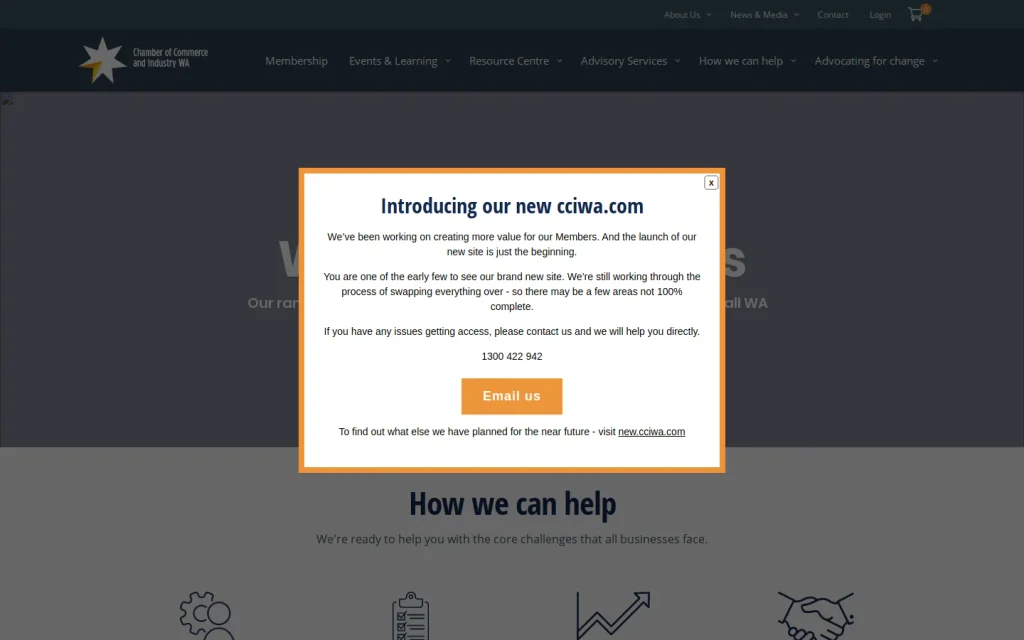
CCIWA homepage, archived 13 December 2019 via the Internet Archive, with the new website announcement. Some background imagery is missing from the archived view.
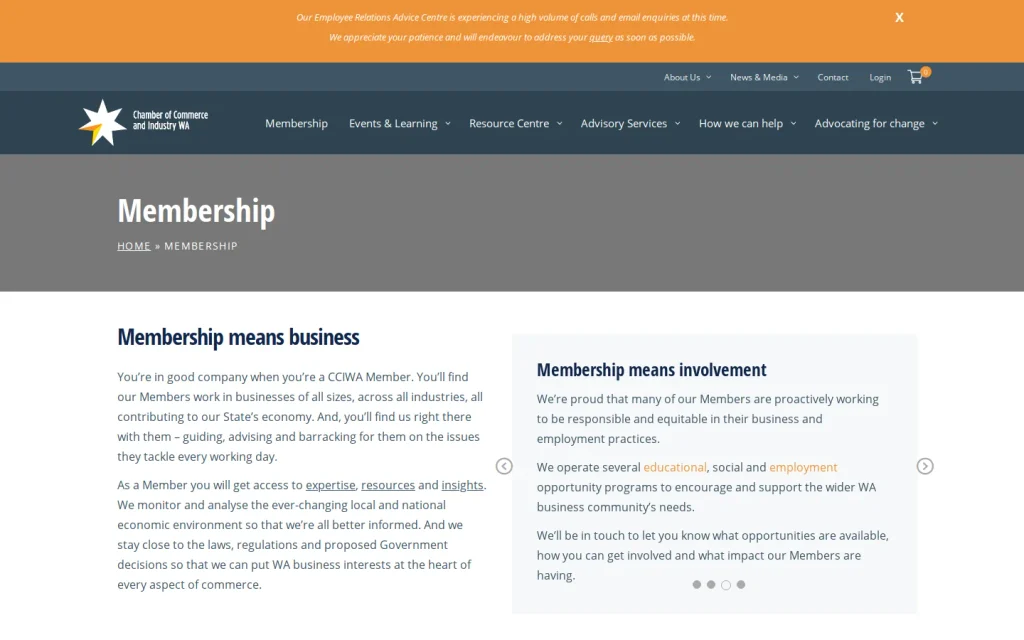
CCIWA’s public membership page, archived 11 May 2020 via the Internet Archive. The CRM synchronisation described above happens behind this interface.
Custom applications and operational workflows
At Doghouse I developed a responsive truck-delivery tracking interface for Boral Concrete using Backbone and Google Maps, with a PHP API module within a larger corporate system. The app was part of a digital transformation effort led by the company to improve their service offering.
Through Code& and Open Studios I’ve worked on CoreMOC, a training and certification application, since 2021. Its rules distinguish recorded hours from hours that count towards a particular certification requirement. Gazetted rules set out by the NSW state government set out how to handle anniversary dates, learning-format limits, amnesties, penalties and multiple certifications. The calculations can’t just be a sum of database fields, as part of my ongoing work I study the specification closely. In the years working on it I’ve refactored legacy parts of the system into new structures and reusable helpers, aligned dashboard and export totals, developed QR-based record imports, and implemented bulk tools for Quality of Life. Old and new regulatory rules also needed to coexist while calculations remained accurate for both.
Grow Sensor was a different kind of problem: I was brought in to fix D3 graphs in a Vue/Ionic and SQLite-backed IoT sensor application. Redrawing was slow and charts disappeared while zooming and panning. I investigated the coordinate and rendering behaviour, refactored the chart drawing code based on my understanding of realtime graphing systems from Langenium and got the blocker working.
These were different applications, but the interesting work in each was turning real operational behaviour into something a user could rely on.
Commerce and digital platforms
At Code&, Leftover Currency has involved a WooCommerce rebuild, expensive query investigation, caching optimisation, deployment and migration, Elasticsearch implementation, and later exchange-rate management workflows for their staff. I developed currency and series interfaces, API endpoints, validation, editing tools and synchronisation controls. The rate-management work reached production in 2026, including sync with external rate data, progress reporting and exports. An API update that fails silently isn’t much use, so I setup Grafana integrations to monitor them and notify engineers if there are issues.
Other engagements exposed me to quite different kinds of commerce. At Lenox Hill I worked on Linneys’ Shopify theme and product interfaces, including options, image presentation, cart and variant behaviour. Through Doghouse, I spent three weeks seconded to Flight Centre’s Brisbane head office in 2016 and then worked for approximately a year across its Drupal 7 website portfolio. The projects ranged from individual product decisions to maintaining a much larger collection of established travel sites, usually as part of a wider team.
We launched a couple of different stores as part of Open Studios including Garrett Ray Jewellery, Gamer Loot and various print on demand stores on popular platforms like RedBubble. These experiences allowed me to be more experimental and design new systems. Gamer Loot resold a lot of stuff from other retailers and so using Promobot I was able to get daily updates on pricing changes and update my own prices to maintain margins.
Tourism, government and public services
In my earlier career I worked for a UK agency called Precedent that specialised in government work. Through them I worked on a number of site builds for local councils in WA like the Shire of Shark Bay and Shire of Murray. As well as various government clients in the UK.
At Doghouse I developed substantial parts of a Drupal 8 platform shared by five regional tourism websites: Australia’s Coral Coast, Golden Outback, North West, South West and Experience Perth (now Destination Perth). I implemented event submission and review, search and notifications, and contributed to listings, membership and mapping and marketing integrations. A submitted event could travel through editorial review and feedback before appearing in search; that workflow was as important as the pages displaying it.
I also developed the custom multisite continuous-integration capabilities and deployment approach, led project management through Jira Kanban, and wrote technical specifications and development tickets. Five sites sharing code still needed a reliable workflow for collaboration to configure, test and release changes.
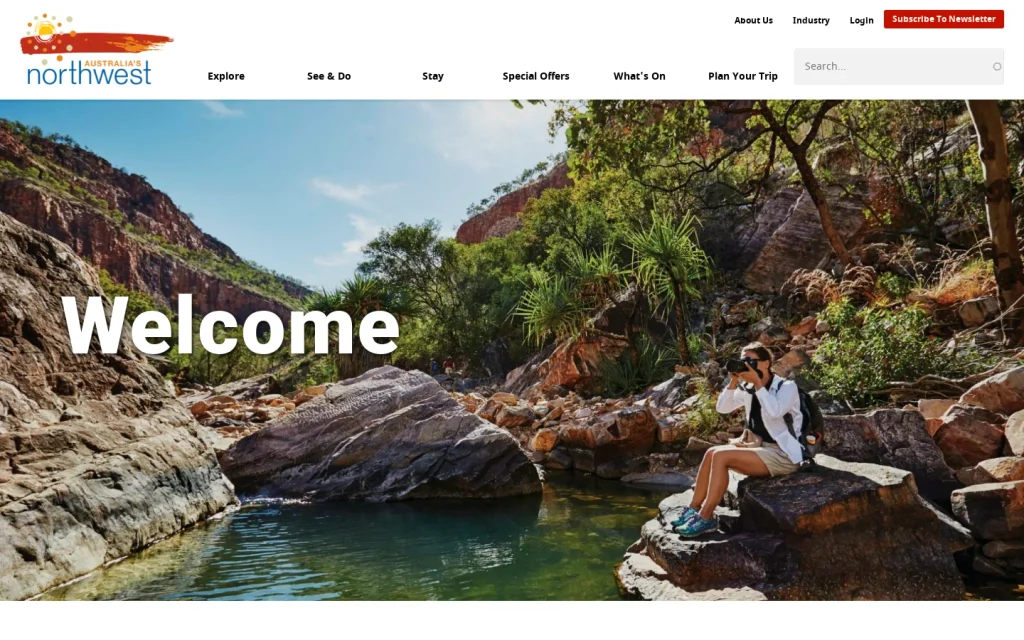
Australia’s North West homepage, archived 12 August 2018 via the Internet Archive. Drupal 8 implementation; development work began in 2017.
Infrastructure, performance and reliability
As a member of iiNet’s Assurance team, I was part of the on call roster which watched over incidents from the company Operations Center. If anything went wrong with software systems, they’d call the rostered person in the team and ask them to step in. One of my proudest moments was working for seventeen hours straight one weekend keeping company systems alive through a bad software update.
Contracting for Living Online in 2019 I implemented staging, GitLab version control, deployment processes, monitoring, technical documentation and developer onboarding. In a direct Open Studios engagement for Independent Roofers Australia, I profiled and improved the existing WordPress site and store. In one before-and-after check the homepage averaged about 6.1 seconds before and 3.3 seconds after; the store admin dashboard went from about 22.7 to 6.6 seconds. They were averages from the same testing round, not unrelated performance scores. A slow shop is also slow for the people running it.
Through Code& and Open Studios I’ve worked across production and staging servers, migrations, PHP and Linux upgrades, deployment automation, monitoring, backup and recovery. I’ve fed optimisation improvements upstream to Trellis which were accepted. And regularly use Ansible, nginx, PHP-FPM and MariaDB, with Grafana, Prometheus and custom DevOps tooling for server side analytics and Disaster Recovery. Rehearsing changes on clones, testing restores and documenting a repeatable procedure can seem like boring ground work, but I find my own fun in it knowing it’s important.
Interactive experiences and original software
Langenium began around 2012 and has moved through multiplayer prototypes, rewrites, abandoned refactors and renewed development. More recently I’ve been working on Three.js rendering, procedural structures, shader materials, flight and combat behaviour, interfaces, indoor collision and reusable game simulation. I separated simulation state from client rendering with a future server in mind, but it’s still a game in development rather than a finished MMORPG. Some of the procedural structures also grew out of the Open Studios website work.
Other projects are deliberately smaller. Euclid is a released WordPress plugin I built to convert simple raster graphics to SVG using Potrace and ImageTracer.js. Kamigen is an ongoing webcomic and website project involving publishing interfaces, Three.js experiments and creative production tools. They aren’t all the same kind of output, but each has given me room to explore a technical idea outside a client brief.
The Open Studios website let me combine more conventional web publishing with a responsive Three.js office, retro homepage, loading sequence and an interactive blog wall. I built the scene and its behaviours using a mix of procedural geometry and existing assets, then connected WordPress content to static publishing. Garrett contributed creative concepts and imagery, including the 3D animated concept and pet portraits; we brought those ideas together in the interactive space.
An ongoing challenge with the 3D virtual office approach has been making sure SEO, accessibility and User Experience are not diminished for some brief special effects and shallow functionality. We have a “1999 experience” that acts as a HTML fallback for SEO and agentic search, as well for people who cannot access the 3D due to other limitations. We recently added a accessibility menu as well.
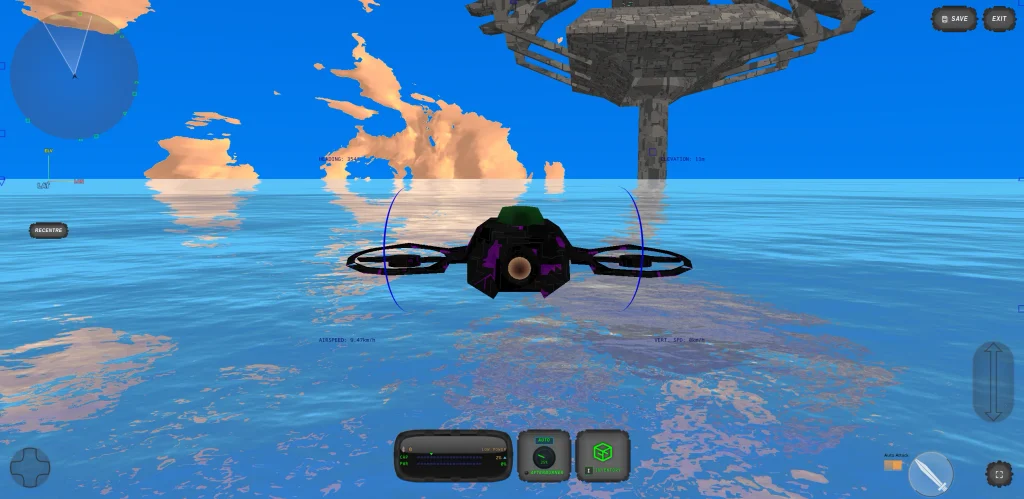
Langenium in development: the flight interface, water rendering and structures in the game world.
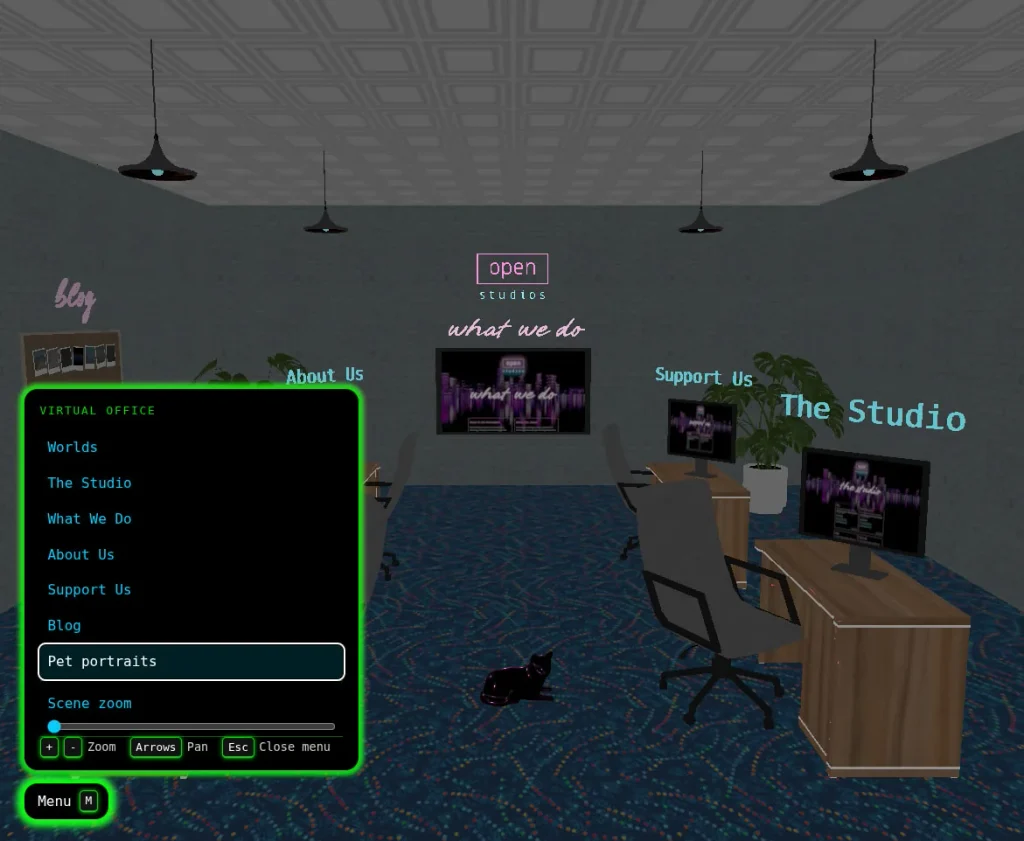
The Open Studios interactive office and navigation. I developed the scene and interactions, with creative concepts and imagery contributed by Garrett.
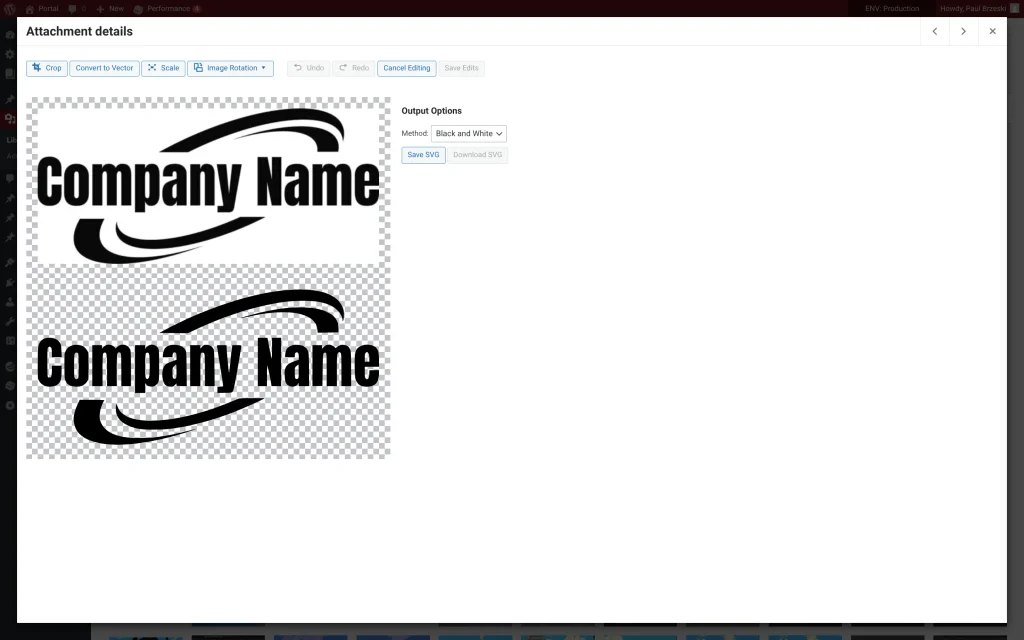
Euclid’s raster-to-vector interface in the WordPress media editor, showing a sample graphic and its conversion preview.
Career history
This is the record of where I worked and the projects I contributed to. Dates attached to projects usually refer to my involvement, not necessarily their original launch. Since December 2018 I’ve worked independently through several agencies and direct engagements, while building Open Studios and our own projects alongside them. Those engagements overlap rather than forming a series of permanent jobs.
Hobbyist (from 1999)
At the age of 11 I learned how to use Visual Basic, Macromedia Flash and Dreamweaver. These visual tools gave me foundational skills in web development that I have built on throughout my career.
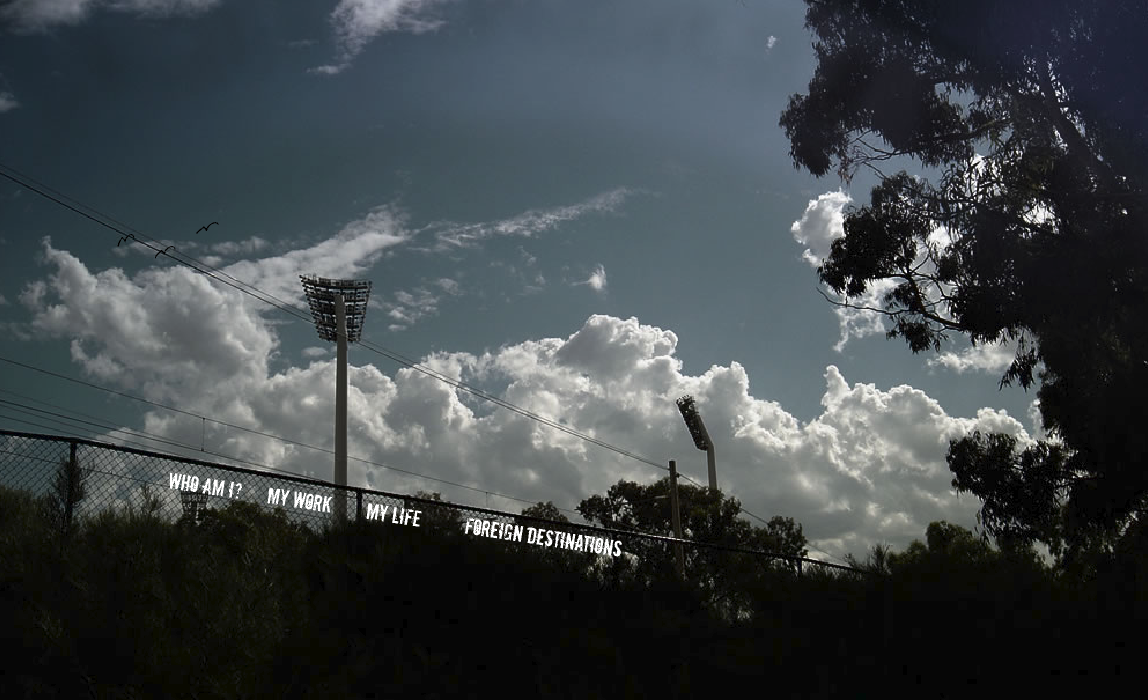
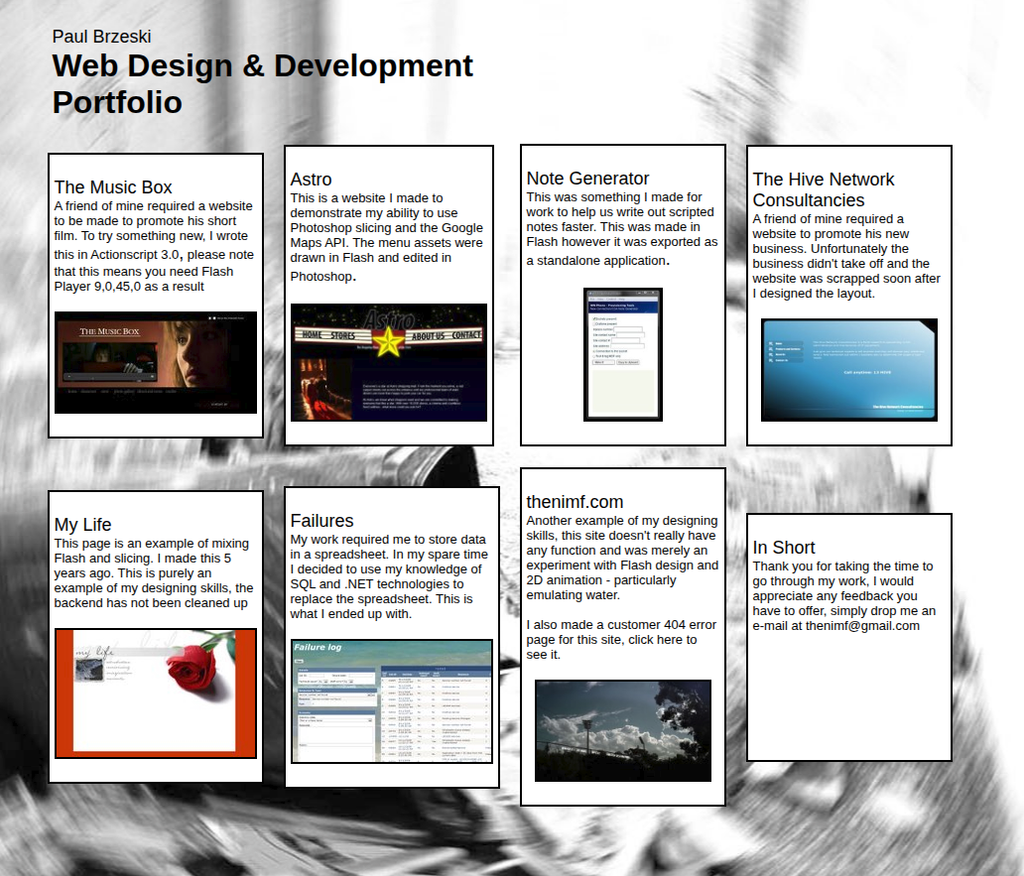
By the age of 12, I was creating my own programs and running Linux on my personal computer. At 14 I attended a course for Flash and continued to make neat little expressions with that tool. The cover image for this article is of a personal site I made in 2002.
If you weren’t there, you may not know but Flash was all the rage of the early 2000s internet. Before YouTube and HTML5, we relied on Flash to give us entertainment via animation and games.
I got into university to study game development after high school, but I found myself needing to work full time and couldn’t pursue a degree at the time.
Westnet (from 2006)
Westnet — telecommunications operations. I joined Westnet in January 2006, working in the call center’s provisioning team starting out as data entry working my way up to team leadership. My role frequently included suggesting process and training improvements. I was regularly liasing between technical teams and my department.
In my spare time, I began to build web based things to solve problems. I exchanged website development for driving lessons, made note generators for my team at work and took my first steps into paid web development making a site for a local band for cash.
That combination led to my pursuing as career as a programmer of web applications.
ATS Solutions and Spider Developments (2008–2010)
ATS Solutions and Spider Developments — business software and websites, 2008–2010. Across ATS Solutions and its sister company Spider Developments, I planned, designed, developed and maintained ASP.NET business software, including CRM, time-tracking and construction parts-ordering applications, alongside custom Windows Services. I also developed Drupal and Joomla websites including a Drupal-based recruitment and HR application connecting client and applicant records with public job advertising. The work included ongoing client relationships, training, online marketing and helping other developers with technical problems.
Precedent (2010–2011)
Precedent — websites, microsites, intranets and custom software, 2010–2011. I worked on PHP websites and .NET systems, testing and infrastructure support across a range of CMS platforms. In my first week I was part of a tender pitch for the Shire of Murray, which we won. Within this role I also wrote technical specifications and helped run public seminars for prospective clients and training workshops for existing ones.
Notable work includes rebuilding the library pages for the University of Southampton UK, maintenance work on the Crimestoppers UK website, technical consultation for Monash University and building multiple WA local council websites end to end.
iiNet (2011–2015)
iiNet — enterprise software and operational tools, 2011–2015. Assurance, Business Intelligence and revenue-integrity work.
Doghouse Agency (December 2015–October 2018)
I joined Doghouse Agency in December 2015 and stayed until October 2018, developing and supporting open-source websites, integrating client APIs and creating custom functionality. The work included Drupal and Magento support, code reviews, documentation and upstream contributions; several of the larger projects appear below.
Flight Centre — Drupal 7 website portfolio, 2016–2017, through Doghouse. In 2016 I spent three weeks seconded to Flight Centre’s Brisbane head office, followed by approximately a year of development work across its Drupal 7 website portfolio through Doghouse. Myself and other resources from Doghouse were brought in to assist with a problem backlog and once that was cleared, we helped them launch campaigns and microsites.
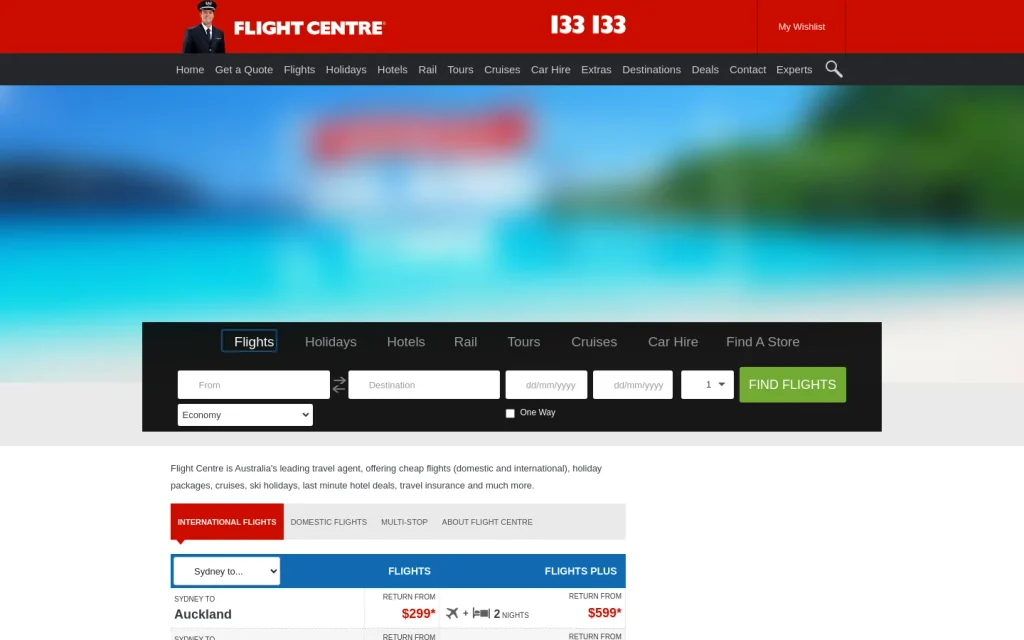
Flight Centre Australia homepage, archived 5 August 2016 via the Internet Archive, during the Doghouse engagement. Navigation and search controls remain legible, although the archived hero imagery is degraded. Captured during my involvement.
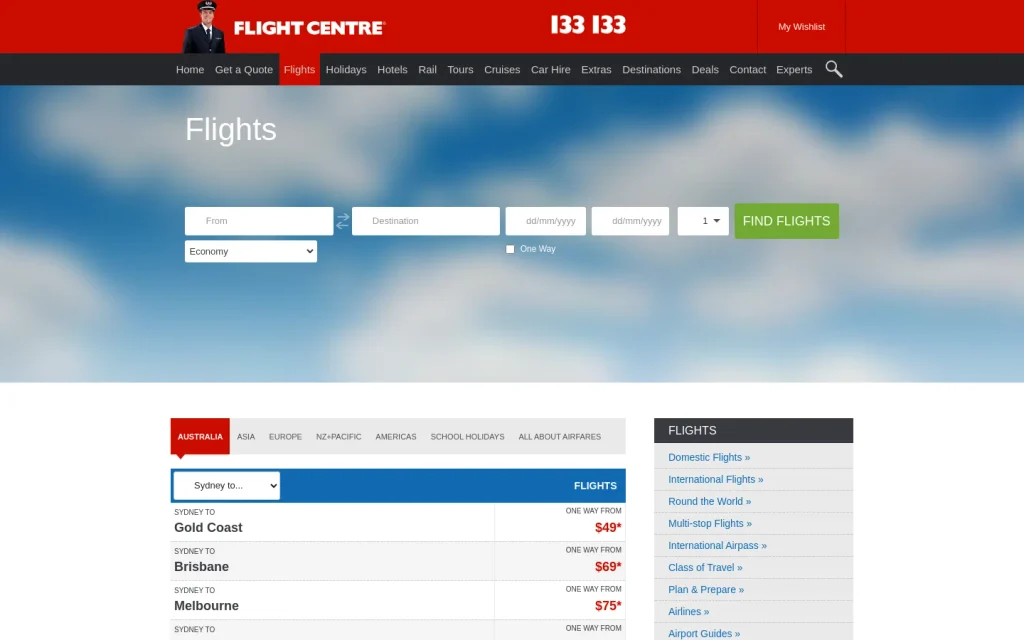
Flight Centre flights search page, archived 15 October 2016 via the Internet Archive. The public search controls and regional deals are preserved; hero imagery is degraded. This is the search entry interface, not a recovered booking transaction.
Regional Tourism Organisation of WA — Drupal multisite, 2017. Five-site platform and deployment architecture, through Doghouse.
Colliers International — website and enquiry integrations, 2017, through Doghouse. I developed and debugged Drupal 8 and PHP integrations with property and CRM services, including SOAP-based enquiry handling, testing and later website support.
Public Sector Commission of WA — website and Lobbyists Register, 2017, through Doghouse. I developed and supported existing Drupal functionality around forms, notifications, account behaviour, attachments and scheduled processing. I investigated how those parts of the application interacted.
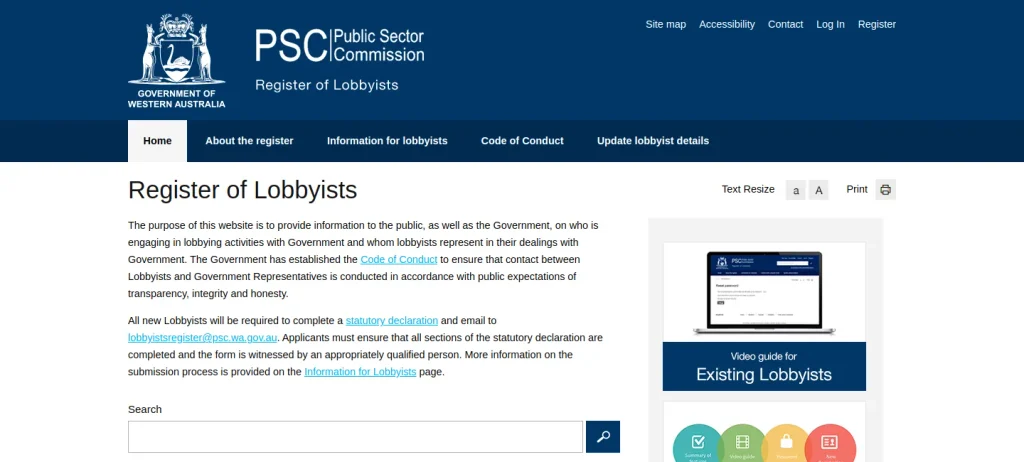
WA Register of Lobbyists, archived 24 October 2017 via the Internet Archive. Cropped above the individual register listings; my work was development and support of the existing Drupal application.
Dale Alcock — Drupal support, 2017, through Doghouse. I worked on webform changes and blog-related support for the existing website.
Abacus / AbacusED — website support, 2017, through Doghouse. I undertook website support and JavaScript investigation.
Department of Training and Workforce Development — authentication assessment, 2017, through Doghouse. I assessed SAML-based authentication work. Implementation was still awaiting commencement in my surviving records.
Boral Connects — truck-delivery tracking application, April 2018, through Doghouse. Backbone, Google Maps and PHP application development.
Scantek (October–December 2018)
Scantek — test automation, operations and documentation, October–December 2018. I developed automated tests within the existing Java, JUnit and Selenium framework and set up a continuous integration workflow and automated testbench. Alongside manual QA and scanner/cloud support, I worked on compliance reporting and setup the company knowledgebase with the Managing Director.
Independent contracting (from December 2018)
I began contracting independently in December 2018. Living Online, Lenox Hill and Code& are engagements within that period, not successive permanent employers. Direct work and studio projects have run alongside them.
Living Online (2019)
Living Online — technical consulting and delivery tooling, 2019. Contracting through Verse Group and a agency in Melbourne, I worked on developer assessment and onboarding, technical documentation, staging environments, version control and build/deployment processes. The work also included monitoring setup and data-connector investigation, rather than a single client website.
Lenox Hill (2019–2020)
CCIWA — website, membership platform and integrations, 2019–2020, through Lenox Hill. Membership, middleware and content migration.
Breast Cancer Research Centre WA — donation and website support, 2019–2020, through Lenox Hill. I worked on WordPress donation forms, notifications, payment-service integration and custom data exports, including PHP and Gravity Forms fixes. This was maintenance and extension of the existing site.
Linneys — Shopify enhancements, 2019–2020, through Lenox Hill. I developed responsive product-page and theme changes, including product options, image presentation and the relationship between enquiry and purchasing. I also worked on variant, cart and third-party app issues around the theme release and subsequent support.
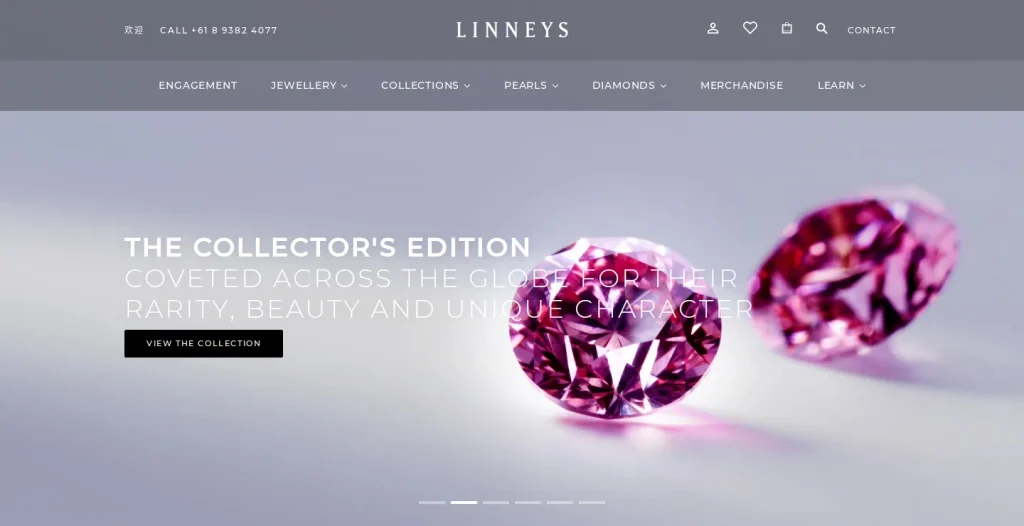
Linneys homepage, archived 29 February 2020 via the Internet Archive, during the Shopify theme and product-interface support period. Header and hero excerpt.
CCIWA eLearning — Moodle and WordPress, 2020, through Lenox Hill. I designed and developed the customised Moodle deployment to CCIWA’s branding and functional requirements, including the SAML single-sign-on integration with its WordPress website. I built the theme and course interfaces, worked on certificates and responsive navigation, and deployed the platform for its June launch. It was my first Moodle deployment; getting users from the website into their learning environment without another login was a substantial part of the work.
WAHTN — WordPress multisite refresh and CRM development, 2020, through Lenox Hill. I worked on migration, launch and follow-up improvements to the website network, and separately on requirements, data modelling and integration work for a SuiteCRM-based replacement CRM. The website launched in June but I left Lenox Hill to return to Open Studios before seeing the replacement CRM work through to completion.
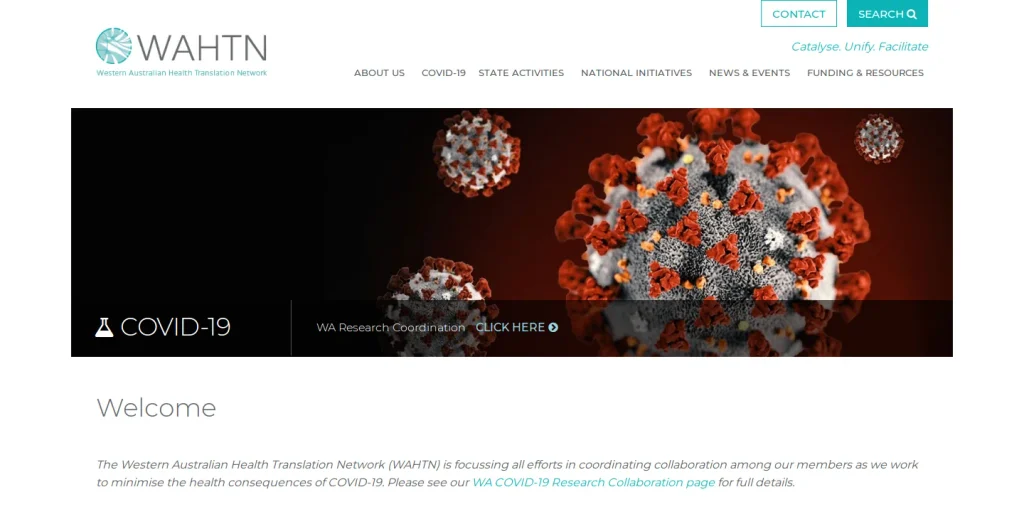
WAHTN homepage, archived 26 June 2020 via the Internet Archive, three days before the documented multisite launch. This is the public website, not the separate replacement CRM.
Involving People in Research / CCI Program — website migration, 2020, through Lenox Hill. I worked on hosting and domain changes, forms and theme changes, and separating public website content from an existing CRM application. This is the research-involvement programme, not CCIWA.
EIT — WordPress rebuild, 2020, through Lenox Hill. I was part of the original pitch and the original Lead Developer on the Engineering Institute of Technology redevelopment. The broader project brief covered CMS selection and setup, fifteen page templates, advanced course search and filters, application forms, content migration and authoring improvements. My implementation work included course templates, search and filtering, pricing displays and form-to-CRM integrations using WordPress, PHP, JavaScript and ACF.
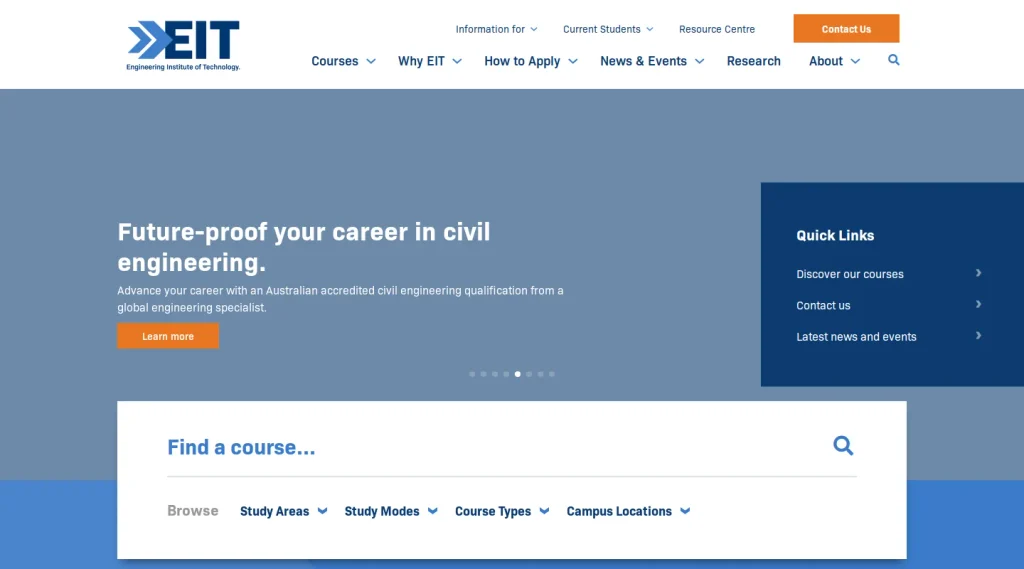
EIT homepage and course-search interface, archived 27 October 2020 via the Internet Archive. This archived public view does not establish the exact launch or sign-off date.
Catholic Education / Catalyst — migration and deployment support, 2020, through Lenox Hill. I handled WordPress QA, server-migration and configuration tasks, and worked on deployment troubleshooting.
Wellbeings — hosting migration, 2020, through Lenox Hill. I restored and migrated the existing WordPress site, resolved compatibility issues and handled the domain and certificate cutover and testing.
Amanda Energy and WA Pure Honey — maintenance and technical advice, 2020, through Lenox Hill. I worked on updates, backups, presentation and performance issues, alongside advice on improvements to the existing websites.
Horizon Power — technical investigation, 2020, through Lenox Hill. I investigated website traffic and prepared findings, alongside technical assessment of possible website changes. The engagement was technical consulting.
TAFE Queensland — platform evaluation, 2020, through Lenox Hill. I contributed to requirements and CMS assessment, including comparison of Drupal and Umbraco.
Code& (2021–2026)
Mindful Mediation — WordPress modernisation, 2021, through Code&. I refreshed an existing legacy site the agency had taken on, improving compatibility, responsive presentation and editable content with ACF, alongside structured data and refining video behaviour.
CoreMOC — training application, 2021–2026, through Code&. Regulatory logic, data modelling and application development.
Leftover Currency — commerce and exchange-rate systems, 2021–2026, through Code&. Rebuild, production search and rate-management development.
Bidfin — website enhancements, 2021–2023, through Code&. I developed contact, partner and navigation changes and later configured and styled LearnDash course and quiz content for staging and user acceptance testing.
Manor FX — commerce and payment integrations, 2021–2026, through Code&. I worked on a Judopay integration, SDK compatibility, payment confirmation and customer notifications, followed by later commerce and support work. Other contributions included delivery-date logic using UK bank-holiday data, reporting and accessibility improvements.
Australian Imaging — theme and commerce development, 2021–2024, through Code&. I developed product, navigation and commerce interfaces for the team’s Sage 10 and WooCommerce rebuild, using Blade, Tailwind, Alpine and ACF/Gutenberg. Later work covered catalogue content, treatment-unit pages and further interface improvements, delivered in phases rather than one all-encompassing launch.
Grow Sensor — graphing and application development, 2021, through Code&. I was brought in specifically to fix a long-standing graphing blocker in a cross-platform plant-sensor application, and got it working. The D3 charts were slow to redraw and some disappeared during zooming and panning; I investigated the rendering and coordinate behaviour, refactored the chart code and integrated it with Vue/Ionic and a SQLite-backed data layer, working alongside other Code& developers. Further chart features continued through development and testing after the original blocker was addressed.
Code& hosting and development tooling — 2021–2026. Production hosting, deployment and recovery; related work included reusable theme and plugin foundations, Composer-based package management and developer documentation.
Ampol partner microsites — 2022–2026, through Code&. I built the NatRoad static site using Eleventy, Tailwind and Alpine to the corporate clients’ specifications, working with a communications consultancy. Later I developed referral handling and worked on content, performance and analytics across partner sites including NatRoad, NECA, HIA, Metcash and Master Builders. The later maintenance and reporting work covered sites beyond the original NatRoad build.
Economy Waste / Skip Bin Hire — pricing tools, 2022, through Code&. I developed a database-backed WordPress pricing interface in place of static price arrays, connecting it to existing booking and checkout behaviour. Later work included postcode and waste-category changes.
South Pacific Private — website and application features, 2022–2026, through Code&. I contributed to a shared WordPress rebuild and ongoing development, including editable Gutenberg/ACF components, content migration, self-assessment workflows, forms, integrations and performance optimisation work. A recurring part of the job was making content manageable by editors without losing the behaviour and presentation the site needed.
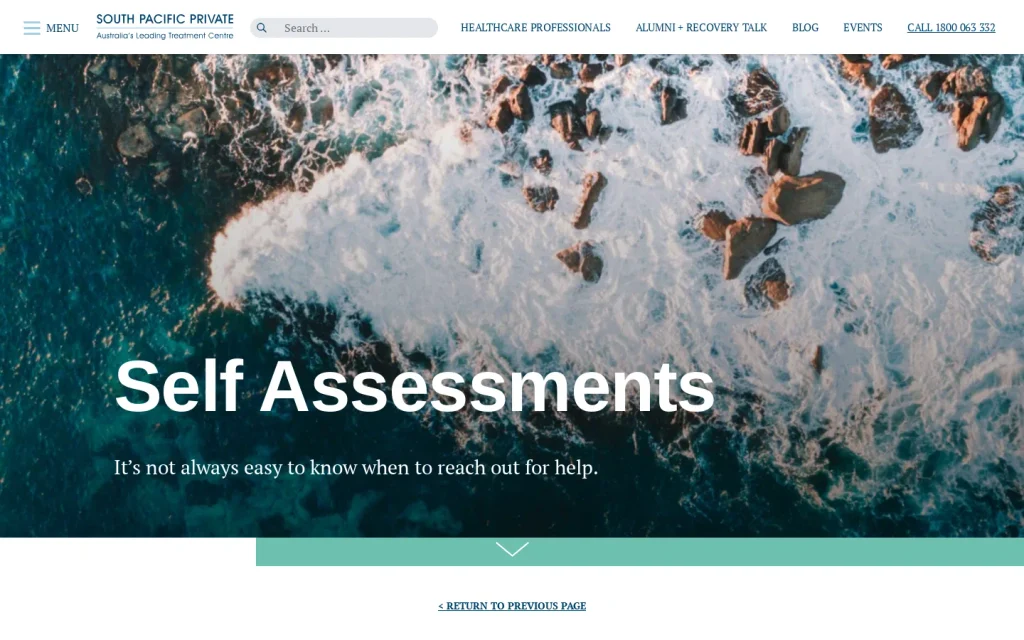
South Pacific Private’s public self-assessment landing page, archived 20 October 2023 via the Internet Archive, from the rebuilt WordPress spp-sage implementation. This shows the public entry point, not an in-progress questionnaire or submitted assessment. My contribution was development within the wider team.
RFMS — training website support and integration development, 2022–2023, through Code& with Scout Branding. I helped unblock the project, worked on booking-related development, testing and handover, alongside maintenance of an existing trainers portal. The replacement integration reached staging and had a working prototype at handover.
Avance Clinical / AvanceCRO — migration and website support, 2022–2023, through Code&. I migrated the existing WordPress site into a Bedrock/Trellis deployment setup, tested forms and email, and worked on content, navigation and analytics integration.
WEConnect International — inherited-site engineering, 2022 onward, through Code&. I worked on build and deployment tooling, theme dependencies, forms and layout, followed by maintenance and updates. The work included repairing build configuration and dependency issues before later updates could be tested and released.
CoreFDM — frontend development and later application work, 2022–2025, through Code&. My earlier contribution included Eleventy/Pug frontend development; in 2025 I built and launched a custom WordPress aftercare booking plugin. The booking application brought together maintenance windows, appointment selection, administration and notifications. These were separate phases using different stacks, rather than one unchanged build.
Direct Ergonomics — WordPress and WooCommerce support, 2023–2026, through Code&. I contributed maintenance, frontend fixes and custom commerce development to the existing site. My work included improvements to a custom ordering portal, repairing a carousel integration and testing related product and interface behaviour.
Trial Wire — WordPress template support, 2023–2024, through Code&. I developed a specialised page template and header/footer changes in the existing site, followed by maintenance work.
The Physiotherapy Partners — frontend support, 2023, through Code&. I corrected layout behaviour and investigated and configured a review-widget integration for the existing WordPress site.
Abra Design — multi-site hosting work, 2023, through Code&. I worked on server upgrades and compatibility troubleshooting across an existing collection of client websites. The scope was infrastructure and application compatibility across the hosting estate.
Code& website maintenance — 2024, with some work continuing later. Routine monthly updates, testing and support work for various clients including Franklin Women, Coventry Grinders, The Breakdown, Riviera Sydney / R Marine, Sue Adcock Designs, Nutbrook Group, Core Mine Training, Better Food Distribution, Easy Read Time Teacher, Dog Culture and Code&’s own site. The scope varied by site, from dependency updates and staging checks to production releases and migration work. The Core Mine public website is separate from the CoreMOC application.
The Banyans — WordPress refactoring and page development, 2025–2026, through Code&. Working with the team, I contributed plugin consolidation, navigation and component refactoring, page rebuilding and maintenance. I rebuilt several pages without an Elementor dependency as part of an ongoing page and component migration.
The Cambridge Code and Galaxy Video — hosting support, 2026, through Code&. I verified existing sites after server updates and carried out operational checks.
Byron Private and Palladium Private — migration work, 2026, through Code&. I contributed to hosting-migration preparation and development-environment setup. The work was part of a wider migration programme, with some tasks still in progress at my last recorded checkpoint.
Direct and partner engagements (2022–2026)
Independent Roofers Australia — performance and support, 2024, direct Open Studios work. Measured performance work on the main website and store.
District 32 — performance consulting, 2024, through Smarter Websites. I worked through plugin and cache configuration with the team and provided a tutorial and handover material. The engagement combined configuration work with training on the existing site.
Revesco Aviation — WooCommerce support, 2024, through GDesign. I worked on product-template and plugin compatibility problems in the existing WordPress store. This was targeted application support.
Cercle — frontend work and freelance support, 2022 and 2024. I first contributed frontend development through Code&, then returned after referral and Code&’s blessing for a direct Open Studios engagement for website updates and scrolling/navigation fixes.
Open Studios and personal projects (alongside client work)
Langenium — browser game and engine, around 2012 onward. Game, engine and R&D history.
Kettlefish — reusable web tooling, documented from 2017, personal / Open Studios. I developed templates and build tooling for websites and applications, published it through npm and later extended it to generate invoices. The code was used in the Level Up/Gamer Loot commerce work and the studio’s earlier invoicing workflow, so it wasn’t just a framework waiting for a project to use it.
Manifold — graphics application and prototypes, 2017 onward, personal / Open Studios. I developed a Fabric.js-based editor with layers, image and path tools, clipboard and drag-and-drop handling, and image tracing; timeline and animation controls remained experimental. In 2022 I also built a Python tracing proof of concept inside Blender, taking the source image from a material’s Image Texture node rather than hardcoding a file, and worked through loading its Python dependencies. These were working editor and integration experiments, with different approaches to the same graphics problems. The foundational work on this project led to my creating the same functionality as the WordPress plugin Euclid in 2026.
Kamigen — webcomic, website and interactive experiments, 2017–2026, personal / Open Studios. I developed the website alongside writing and producing the comic; by 2022 I had published more than 120 pages and was working on the fifth issue. Website work continued through a new homepage and hosting migration in 2026. The project has also involved Three.js interfaces, demo scenes and experiments in production tools; one Eleventy rebuild was abandoned, while comic publishing continued. It has its own ongoing production history, separate from the game prototypes that accompanied it.
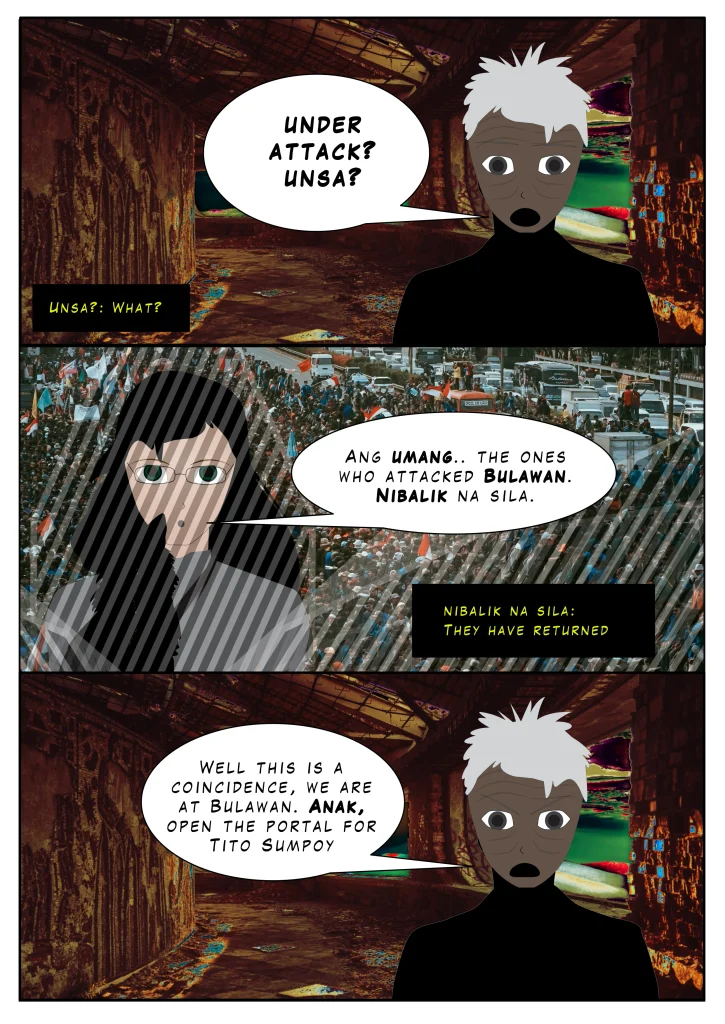
Page 132 of Kamigen, the Filipino sci-fi themed webcomic I write and produce alongside developing its website.
Paul Brzeski — personal and consulting website, documented from 2017. I’ve rebuilt and maintained my own site across several versions, including professional pages, blogs and experiments. In 2025 I moved it to a customised WordPress setup and migrated my articles from Medium.
Open Studios — studio website, November 2019 onward. Garrett and I established the studio to bring our personal projects together. Immersive website and publishing integration; earlier work included the studio’s branding, web presence and project presentation.
Digimart World / Level Up / Gamer Loot — commerce development, 2020–2022. I developed a WordPress and WooCommerce theme, product and checkout interfaces, payment testing and supplier/pricing automation across the work that became Gamer Loot. Gamer Loot soft-launched in March 2021 and was taken offline in 2022; I’m keeping it here even though it is no longer an operating site.
Promobot — publishing automation, 2020–2022, personal / Open Studios. I built a Node.js and database-backed service for importing content and publishing through social platforms, including handling failed uploads and content retirement. It supported several different project and merchandise streams including scraping the latest prices from vendors.
Bear Clothing Designs — digital artwork and merchandising, 2020–2022. I produced artwork, branding and products for merchandise platforms and connected that work to my publishing tools. The work centred on design and publishing through merchandise platforms.
Khajiit / ProductManager — product-data automation, 2021. I separated supplier-checking code into its own project and developed scheduled availability and price change checks with emailed reports. It grew out of the practical requirements of setting up a passive income stream.
Gray Jewellery / Garrett Ray Jewellery — website and digital work, 2021 onward. Working with Garrett on his jewellery business, I implemented Shopify improvements, corrected product and collection imagery, and handled competitor analysis, analytics and content and marketing work. Garrett’s jewellery and creative practice provided the products and direction for that collaboration.
Graphics and machine-learning experiments — 2022, Open Studios. Alongside Manifold I tested silhouette datasets and image-generation workflows, including DCGAN, StyleGAN3 and Stable Diffusion. These were R&D experiments researching possible new creative tools, not released studio or client commissioned AI products.
Studio analytics and hosting automation — 2023 onward, Open Studios. I set up self-hosted Matomo and monitoring, migrated historical analytics data and developed repeatable hosting and deployment configuration. This includes my Trellis-derived hosting automation, Lattice, and work preserving older analytics history while moving it into Matomo. Since establishing the self hosted approach I’ve also added the ability to track agentic traffic and server side requests via Nginx configuration.
Open Studios business application — 2024 onward. I built a WordPress and Pods-based application for the studio’s invoices and related business records, replacing an earlier static workflow. It has been used for invoicing since August 2024, with later work on relationships, a knowledgebase and editing workflows. I kept its content definitions as JSON under version control rather than leaving the model entirely inside the WordPress database, or PHP code.
Glass Shield / Liquid Glass — digital marketing and publishing, 2024, Open Studios. I handled client coordination, video review and publication, campaign setup and reporting. Garrett did most of the video production.
Technical writing — 2024 onward. I published an article about implementing Blender Principled BSDF materials in Three.js, alongside writing about development practices and the studio’s projects. Explaining an implementation is a different job from making it work, and the writing has become another part of the technical work I keep doing.
Euclid / Open Studios Image to Vector Converter — development from 2025, released in 2026. WordPress plugin development and release.
BTN Music Club — website review and strategy, 2026, Open Studios. I reviewed the website and prepared recommendations. The engagement was advisory.
Earlier work by sector
This is a loose collection of sites I contributed to earlier in my career, organised by sector.
Government and community organisations. City of Nedlands, Shire of Murray, Shire of Shark Bay, Crimestoppers UK, RSPCA Australia, RSPCA WA and Sustrans UK.
Education. North Metropolitan TAFE (WA), Monash University, the University of Southampton and the University of Birmingham via Precedent. Orpheans Dance Studio via my own consultancy.
Commercial, tourism and property websites. Colliers International, Content Living, Experience Perth and sister sites, New Choice Homes, GMF Health Insurance, Perth Zoo, Murphys Estate Agents and Webb & Brown-Neaves.
E-commerce. Adultshop Australia. Biowashball Australia, Blundstone, Laurance Wines, Trailer Boats Australia and The Smiling Gift Company.
Looking back
Reading all of this together, I don’t see a particularly tidy progression from one speciality to the next. There were enterprise applications alongside websites, games alongside client work, and periods where keeping an existing system working took more time than building anything new.
There are connections, though. Working with data in telecommunications made later integration and infrastructure problems more familiar. Game development gave me another way to think about software. I stopped asking whether something worked and started asking whether it was enjoyable and rewarding to use. Maintaining websites made me more interested in their underlying architectrure and how to scale reliably.
I still move between different kinds of work. Some days that means understanding a rule well enough to turn it into code. Other days it means finding out why a page is slow, or testing whether an idea for a game will work on a phone. The technologies have changed, but I can recognise parts of the earlier work in what I’m doing now.
There are still gaps on this list, especially in the older agency work. Some of these projects were part of someone else’s working day for years; others were things Garrett and I made because we wanted them to exist. I’m glad to have a record of both.